Meal Substitution Macro Cost Checklist: Compare Macros, Pack Cost and Waste
Joey Habib · · 11 min read
- meal substitutions
- macro tracking
- grocery budgeting
- protein cost
- meal planning
A meal substitution macro cost checklist helps you decide whether a replacement fits the meal, your macro plan and your grocery budget—not just whether its shelf price or protein number looks appealing. Compare the same amount of each food, calculate the change for the whole portion, then check the pack cost and what will happen to any remainder before changing your Coles list.
This guide is for Australian shoppers comparing ingredients for planned meals, including people tracking protein or other macros. Use current product labels and prices for the items you might actually buy; the examples below are illustrative calculations, not current Coles prices or nutrition claims about specific products. Start by deciding which requirement matters most, then reject options that fail the meal before ranking those that remain.
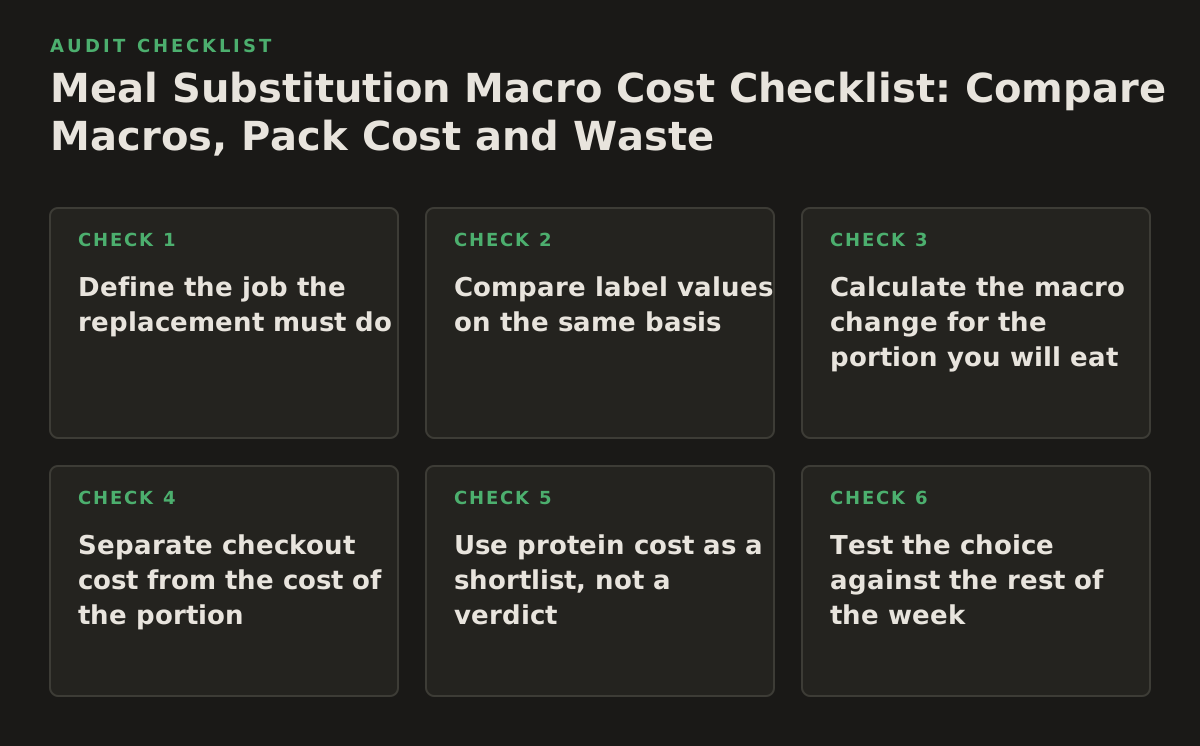
1. Define the job the replacement must do
Use this check when you are choosing between foods that play different roles, such as replacing a protein in a dinner or changing a yoghurt in a snack. Two products with similar names may contribute differently to the meal’s texture, preparation, portion size and macros. Decide what you need the substitute to preserve before looking for a winner.
Set a priority and a permitted trade-off
- Keep fixed: the number of people eating, the meal’s role, and any dietary or household requirements.
- Choose a main goal: for example, lower checkout spend, more protein in the meal, or using food already on hand.
- Name a trade-off: such as a different texture or a small change in carbohydrate, if that is acceptable for this meal.
This works because a clear priority prevents one attractive number from disguising a poor fit. A low pack price is not useful if the replacement no longer works in the recipe; a high-protein option is not automatically a good choice if it pushes the meal’s energy or cost away from your plan.
Failure mode: trying to improve every metric at once can lead to a replacement that is costly, inconvenient and still unsatisfying. For an illustrative quick lunch, decide first whether the priority is meeting a planned protein amount or reducing spend. Keep preparation and meal role in view, then use the other criterion to choose between options that work.
2. Compare label values on the same basis
Use this check when packaged products show different serving sizes or one label is easier to read than another. Compare like with like: a per-serving value only answers your question if that serving matches what goes into your meal. Australian nutrition information panels show nutrient information against a stated serving and per 100 g or 100 mL, so check the basis as well as the number; see Food Standards Australia New Zealand’s guide to nutrition information panels.
Record the exact product and amount
- Write down the product variant, such as plain or flavoured, and its pack size.
- Note whether the nutrition values apply per 100 g, per 100 mL, or per stated serve.
- Record the amount you expect to use in the recipe.
- Check whether values describe the food as sold or a prepared version.
For example, imagine one product lists protein per 100 g and another per 170 g serve. Convert both to the amount you plan to eat before comparing them. If you will use 150 g, calculate each product’s contribution for 150 g rather than comparing the printed serving figures directly.
Failure mode: comparing per-serve protein from one pack with per-100-g protein from another makes the larger serving look better simply because it is larger. If a label does not give the detail you need, a food-composition database can provide an estimate, but it may not match an exact Australian brand or recipe. USDA FoodData Central identifies foods and provides nutrient data; use a close match as an estimate, not as a substitute for the product’s own label: USDA FoodData Central.
3. Calculate the macro change for the portion you will eat
Use this check when the replacement will be used in a different quantity from the label’s serving or recipe amount. Convert label values to the amount in your meal. For a per-100-g value, use: nutrient per 100 g × grams used ÷ 100. Repeat for protein, energy, carbohydrate and fat. For a per-serving value, multiply by the number of label servings represented by your portion.
Compare the full meal before and after
The ingredient is only one part of the result. A substitute may change the amount of sauce, oil, topping or side needed to make the meal work. Keep the recipe yield and number of portions the same in both versions, and include any added ingredients in the comparison. That gives you a meal-level estimate rather than a misleading product ranking.
Illustrative example: a 150 g portion of an ingredient labelled at 20 g protein per 100 g contributes 30 g protein. The same weight of a hypothetical substitute labelled at 12 g per 100 g contributes 18 g. The swap reduces the meal’s protein by 12 g before considering the rest of the recipe. You can then decide whether another ingredient or a different portion restores the meal to your plan without creating an unacceptable change elsewhere.
Failure mode: checking only protein can hide a meaningful change in energy, carbohydrate or fat. Record the full meal’s relevant macros on both sides of the swap. Protein requirements also vary with individual context; the NIH Office of Dietary Supplements discusses protein and exercise in its Exercise and Athletic Performance fact sheet. Treat your own target as personal guidance, not something established by a single substitution or example.
4. Separate checkout cost from the cost of the portion
Use this check when a recipe uses only part of a pack or competing options come in different sizes. The amount charged at checkout affects the shop today; the amount allocated to the meal helps compare recipes. They answer different questions, so record both.
Calculate the two costs
- Portion cost: pack price × amount used ÷ usable amount in the pack.
- Planned pack cost per meal: pack price divided by the number of planned meals that will use the pack.
- Checkout impact: the full price of the pack you need to buy for the plan.
For an illustrative example, an $8 pack used across four planned meals allocates $2 of purchase cost to each meal if the pack is fully used. But the shopper still needs to pay $8 at checkout. If the recipe uses only part of the pack and no other meal is assigned the remainder, the $2 figure understates the cost of the plan in practice.
Failure mode: treating an allocated serving cost as the amount needed to buy the ingredient. Before shopping, check the current shelf price and pack size for the exact product; a remembered or old price may no longer match. If you want a more reliable weekly estimate, assign the remaining amount to a specific planned meal rather than assuming it will be used.
5. Use protein cost as a shortlist, not a verdict
Use this check when comparing products that could reasonably fill the same role and protein value matters to your plan. Cost per 100 g of protein can help identify candidates, but it does not say whether the product fits the recipe, provides a suitable portion, or will be eaten before it goes to waste.
Calculate protein value consistently
To estimate cost per 100 g of protein, divide the pack price by the total protein in the pack, then multiply by 100. Estimate total pack protein from the label using protein per 100 g × pack grams ÷ 100. Keep the product state and pack size consistent. If some contents are discarded or the edible amount differs from the pack weight, the label-based calculation may not reflect what you consume.
You can also compare protein per dollar for the portion: protein in the meal portion divided by its allocated cost. Use this alongside the meal’s macro change and pack cost. A product that looks efficient by protein cost may still require a larger checkout payment or fit the recipe poorly.
Australian dietary guidance considers food patterns and variety rather than selecting foods by a single nutrient alone; see the Australian Dietary Guidelines. This is a useful reminder that a protein-cost ranking is a comparison tool, not a complete judgement of dietary suitability.
Failure mode: choosing the lowest protein cost even when the product is not wanted in the meal or will be wasted. For an illustrative comparison, shortlist two products with acceptable meal fit, then use protein cost to distinguish them. If the cheaper candidate needs an extra ingredient or a pack size that will not be used, include those consequences before choosing.
6. Test the choice against the rest of the week
Use this check when a pack is larger than the recipe needs, the ingredient is perishable, or the household shares meals. A replacement can look efficient on a single-recipe calculation but create a leftover that has no place in the week. Planning that use makes the cost estimate more realistic and may reveal a better pack size or a different substitute.
Give the remainder a destination
- Identify how much will remain after the first meal.
- Name a second meal that uses it and check that the timing is practical.
- Check whether the substitute changes cooking steps or requires additional ingredients.
- Consider whether everyone eating the meal accepts the ingredient and texture.
Failure mode: counting “we’ll use the rest somehow” as guaranteed savings. If there is no named meal, treat the remainder as uncertain rather than crediting its value to the recipe. For example, a larger tub may have a lower calculated cost per portion, but that advantage depends on having a planned second use that fits the household’s meals.
This step also protects the macro comparison: if using up the pack means adding the ingredient to a different meal, include that amount in the second meal’s log rather than attributing the whole pack to the first recipe. A substitution affects the weekly plan as well as the plate in front of you.
7. Rank candidates with a reusable decision table
Use the same fields for each candidate, then apply your priorities in order. First remove options that fail dietary, household or recipe requirements. Next compare the portion-level macro change. Then consider checkout cost, planned use and protein value. “Pass” means the option meets your own requirements; it is not a universal nutrition threshold.
| Check | Record for each option | Decision rule |
|---|---|---|
| Meal fit | Role, portions, preparation and constraints | Remove options that cannot work in the meal. |
| Macro change | Protein, energy, carbohydrate and fat for the portion | Keep options within your chosen target or trade-off. |
| Checkout cost | Current pack price and pack size | Check the full purchase against the available shop budget. |
| Meal cost | Allocated cost for the planned amount | Compare using the same portions and recipe yield. |
| Protein value | Cost per 100 g protein or protein per dollar | Use to compare viable options, not as the only rule. |
| Remainder | Amount left and its planned use | Do not count unplanned use as certain savings. |
For an illustrative lunch comparison, one candidate might cost less per 100 g of protein but require a pack with no planned second use. Another might cost more for the portion while fitting the recipe and the planned shop. If reducing checkout spend is the main goal, the larger pack may be a poor fit; if another meal already uses it, the choice could change. The table makes that difference visible instead of forcing one metric to decide.
8. Implement the substitution in sequence
Use this order when updating a meal plan or shopping list so the selected product, recipe amount and cost estimate stay aligned.
- Write the meal goal. Note why you are changing the ingredient and which priority will decide between workable options.
- Check the exact product. Record its label basis, pack size and current price for the item you may buy.
- Calculate the meal portion. Convert nutrients to the amount used and compare the full recipe before and after.
- Calculate the shop impact. Record checkout cost, portion allocation and the planned use of any remainder.
- Choose among viable options. Apply the table, giving meal fit and your chosen macro priority more weight than a single product ranking.
- Update the plan and review it. Make the recipe, grocery list and food log refer to the same product and amount.
A short record—product, portion, macro difference, pack price and intended uses—makes the next substitution easier to compare without treating estimates as exact for every prepared meal. For Australian Coles shoppers who want to connect macro targets with meal and grocery-cost planning, Macronomics is in staged beta; check the site for current waitlist and onboarding information.
Authored with NotFair SEO