How to Compare a Supermarket Price With Your Macro Budget
Joey Habib · · 12 min read
- supermarket price
- grocery budgeting
- macro tracking
- protein cost
- meal planning
A supermarket price is only useful for meal planning when you connect the shelf or online pack price to the amount you will actually eat. For a Coles shopper, that means checking the whole-pack cost, edible serves, protein delivered, storage risk and the price of realistic substitutes—not simply choosing the lowest ticket. The most useful comparison is usually cost per serve or cost per gram of protein, then a check that the purchase fits this week’s cash budget.
What a Supermarket Price actually tells you
The displayed price answers one narrow question: how much money is required to buy that pack at that moment and under the conditions shown. It does not automatically tell you what one dinner costs, whether the pack will be used before it spoils, or how efficiently it supports a macro target.
For a macro-based household, separate five pieces of information:
- Pack price: the amount paid at checkout for the selected product and size.
- Usable quantity: the amount likely to be eaten after draining, trimming, cooking or discarding.
- Nutrition: protein, carbohydrate, fat and energy per stated serving or per 100 grams.
- Meal yield: how many planned portions the pack creates.
- Purchase friction: whether the item requires a second ingredient, special storage or a quick expiry.
Those details matter because retail labels commonly compare products using a unit price, while meal planning needs a meal-level price. A large tub of yoghurt can look expensive beside a small tub but still be cheaper per 100 grams. Conversely, a family pack can look efficient and become poor value if half of it is forgotten in the fridge.
Ticket price, unit price and meal price
Ticket price is the amount for the pack. Unit price converts different pack sizes into a common measure, such as dollars per kilogram. Meal price goes one step further: it allocates the cost of the amount used in a recipe or planned serve.
For example, an illustrative starting calculation might treat a $12 pack of chicken as four planned portions. Its meal allocation is $3 per portion before the cost of rice, vegetables, sauce and cooking fat. If you use only half the pack this week, the other half is not automatically wasted; it is an asset for a later meal if it is safely stored and actually scheduled.
Australian food prices move over time, and the Australian Bureau of Statistics publishes consumer price data that includes food and non-alcoholic beverage categories. That index describes price movement across the economy, not the price of your chosen Coles pack or the cost of your personal meal; use the ABS Consumer Price Index as broad context rather than a shopping-list calculator.
Why “cheap per kilogram” can mislead
A raw ingredient may be inexpensive per kilogram but deliver little convenient protein per dollar once you account for cooking loss or the amount needed to make a satisfying meal. A sauce may be costly per kilogram but use only a small amount per portion. The correct comparison depends on the job the food performs.
For a gym-goer, the useful question may be “How much does this breakfast contribute toward my protein target?” For a family, it may be “How many lunches can this pack cover without another shop?” For a coach, it may be “Can the client repeat this meal on a busy weekday?” A good supermarket price comparison starts with that decision.
Why Supermarket Price matters for macro budgets
Macro tracking can fail financially when nutrition targets are treated as separate from shopping behaviour. A person may hit protein on paper by adding premium convenience foods, then discover that the weekly basket is unaffordable. The reverse problem also occurs: a very cheap basket may technically fit the budget but leave too little protein, variety or preparation time.
Protein cost is a useful lens, not the whole verdict
Calculate protein cost by dividing the cost allocated to the food by the grams of protein supplied by the amount you eat. An illustrative example: if $4 of a meal contributes 40 grams of protein, the protein component costs $0.10 per gram. That figure is not a universal quality score. It ignores fibre, micronutrients, taste, satiety, preparation time and whether the household will eat the food.
Use protein cost to compare foods doing a similar job:
- A breakfast yoghurt against eggs, cottage cheese or a milk-based option.
- Chicken, lean mince, tinned fish, tofu or legumes in a main meal.
- A ready-to-eat protein product against a planned meal assembled from ordinary groceries.
- A snack intended to add protein against a snack intended mainly to provide energy or convenience.
Cost per gram of protein is especially helpful when a client has a fixed protein target and limited grocery money. It becomes less useful when a shopper compares a complete meal with a single ingredient. Compare like with like, or calculate the full plate.
Whole-pack cash flow changes the decision
Meal costs are consumed gradually, but supermarket spending happens at checkout. That creates a practical distinction between portion economics and weekly cash flow. A bulk pack might lower the planned cost per serve while pushing this week’s basket above the household’s available cash.
For budgeting, record both:
- Checkout cost: what must be paid now, including the full pack.
- Allocated meal cost: the share assigned to meals planned for this period.
Illustrative starting policy: if a weekly grocery plan has a $150 ceiling, mark a $10 pack as $10 against the checkout ceiling even when only $5 is allocated to this week’s meals. The remaining $5 can be treated as planned stock only if it has a named future use. This prevents a spreadsheet from appearing on budget while the checkout total is not.
For food safety decisions, follow the product label and authoritative Australian guidance rather than relying on a meal-planning rule. Food Standards Australia New Zealand explains consumer food-safety principles, including safe handling and storage, through its food safety information. Storage life is therefore a constraint on value, not merely an optional note.
How to convert a Supermarket Price into a useful comparison
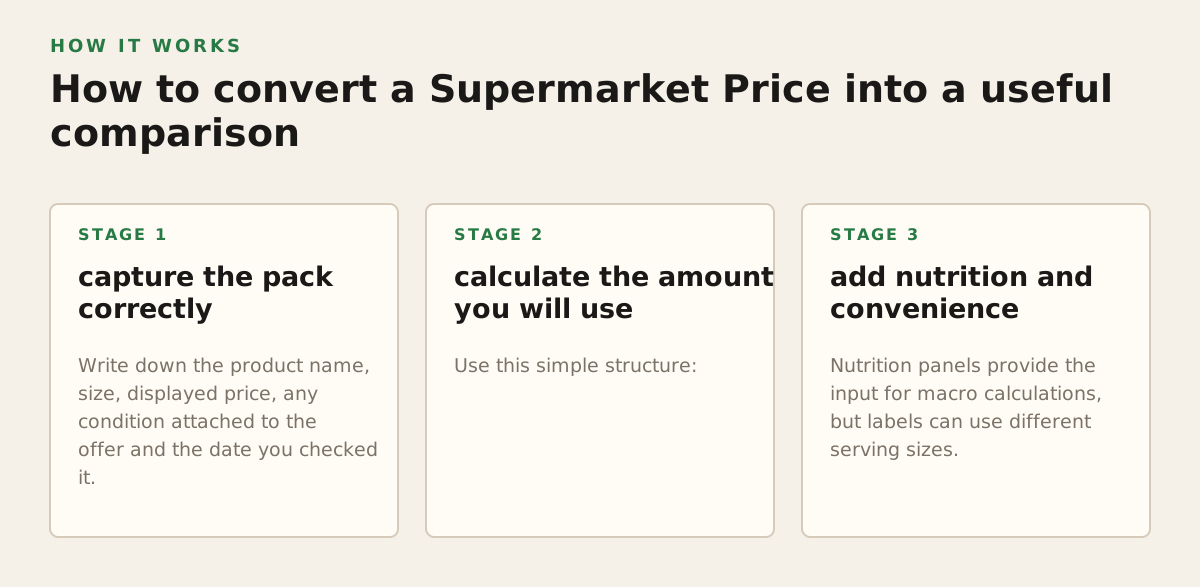
A practical workflow moves from the pack to the plate in a fixed order. This reduces the temptation to justify an appealing special or a high-protein product after buying it.
Step 1: capture the pack correctly
Write down the product name, size, displayed price, any condition attached to the offer and the date you checked it. If you are using an online basket, record the price shown for your selected fulfilment method. Do not assume that a search result, catalogue image or remembered shelf price is still the applicable checkout price.
Coles sets out shopping, payment and order-related terms in its official terms and conditions. Those terms are the appropriate place to check how an online purchase is governed; they do not replace checking the product’s current listing, selected size or delivery details when estimating a basket.
Then identify whether the displayed amount is:
- A standard price for the selected pack.
- A temporary offer with a stated end date or purchase condition.
- A member-linked or account-specific offer.
- A price for a different size, flavour or variety than the one in your meal plan.
Step 2: calculate the amount you will use
Use this simple structure:
Cost used = pack price × amount used ÷ amount in the pack
For an illustrative example, a 1,000-gram pack priced at $8 contributes $4 to a recipe using 500 grams. If cooking or draining changes the yield, use the quantity that your recipe actually serves rather than blindly applying the label weight.
For a meal plan, calculate the full recipe:
Meal cost = sum of the allocated ingredient costs ÷ planned portions
A recipe using half a meat pack, one can of tomatoes, some rice and vegetables should include the share of each item used. If the whole can is used, allocate the whole can. If a jar of sauce supplies several meals, allocate only the quantity used and record the remainder as stock.
Step 3: add nutrition and convenience
Nutrition panels provide the input for macro calculations, but labels can use different serving sizes. Convert everything to a common basis before comparing. Per 100 grams is often useful for products with different pack sizes; per planned portion is better for a recipe your household will repeat.
Illustrative calculation:
- A meal uses ingredients allocated at $2.40, $1.60 and $1.00.
- The recipe makes four planned portions.
- Total recipe cost is $5.00.
- Cost per portion is $1.25 before optional extras not included in the calculation.
If each portion contains 32 grams of protein in the illustrative plan, the meal contributes approximately $0.039 per gram of protein. Treat the result as a comparison tool, not a promise that the meal is nutritionally complete or suitable for every person.
Where Supermarket Price comparisons break
The arithmetic is simple; the assumptions are where budgets go wrong. A robust comparison makes those assumptions visible.
Promotions can create false savings
A discount is not a saving if it causes an unplanned purchase, replaces a cheaper item, or leads to waste. Compare the promoted product with the best realistic alternative, not with its own previous price. A special can be worthwhile when the food already has a scheduled use, the household can store it safely and the purchase does not displace higher-priority items.
Illustrative starting policy: treat an offer as a budget win only when three conditions are met—there is a planned meal, the discounted pack will be used within its storage plan, and the total checkout remains inside the household’s cash ceiling. This is a decision rule, not a claim about how every promotion works.
Watch for these traps:
- Buying two packs to unlock a discount when one would have been enough.
- Comparing a member price with a non-member price without checking eligibility.
- Using the price of a smaller pack to make a larger pack appear cheaper.
- Ignoring the cost of the ingredient needed to make the discounted item usable.
Waste changes the effective price
If a pack costs $10 and the household eats only three-quarters of it, the food consumed has an illustrative effective cost of $13.33 for the edible amount. That is not a reason to avoid larger packs automatically. It is a reason to distinguish purchased price from consumed price.
Waste can be physical, behavioural or planning-based. Physical waste is food discarded after spoilage. Behavioural waste is food left because the household dislikes the recipe. Planning waste is food that was technically edible but had no scheduled place in the week. Each type needs a different fix: smaller packs, better recipes or a more disciplined meal map.
Frozen, canned and shelf-stable options can reduce timing pressure, but they may have different nutrition, texture or preparation trade-offs. Check the actual label and your intended use rather than assuming that a preservation format is automatically cheaper.
Nutrition and price data are not perfectly interchangeable
Product pages and packaging may present nutrition per serving, per 100 grams or per prepared product. A dry ingredient can also gain weight when cooked, while its total macros remain tied to the original quantity. If you compare dry rice with cooked rice without aligning the basis, the result can look precise and still be wrong.
For a coach or trainer, ask the client to use one consistent convention in the tracking system. For example, weigh a batch before cooking and divide it into known portions, or use a reliable cooked-weight method every time. The best convention is the one the client can repeat without creating extra friction.
How practitioners apply the method to a weekly Coles shop
A workable plan begins with meals, then assigns ingredients, then checks the basket. Starting with isolated “cheap foods” often produces a pile of ingredients rather than repeatable meals.
Build around anchors and flexible supports
Choose a small number of protein anchors that can appear in several meals. Add flexible supports—carbohydrate staples, vegetables, fruit, sauces and snacks—that can move between recipes. This reduces the risk that one missed meal leaves an expensive ingredient without a purpose.
An illustrative weekly structure might include:
- One cooked protein used in a bowl, wrap and leftover lunch.
- One quick protein for breakfasts or post-training meals.
- One shelf-stable or frozen backup for a night when cooking fails.
- Two or three vegetable formats so the plan is not dependent on one perishable item.
- One planned meal using existing pantry or freezer stock before buying another version.
The exact number of meals and budget should come from the household. The structure matters because it connects basket flexibility with macro consistency.
Use a substitution ladder
When a chosen item pushes the basket over budget, do not replace it randomly. Move through a defined ladder:
- Check whether a different pack size gives a better whole-week fit.
- Compare an equivalent protein with a different preparation format.
- Reduce a premium add-on while keeping the meal’s protein anchor.
- Swap the recipe for one using existing pantry or freezer ingredients.
- Move the expensive meal to a later shop only if the macro plan still works.
This protects the meal’s purpose. If the target is a high-protein lunch, replacing the protein with a low-protein filler may meet the budget while failing the actual job.
Review the basket after the shop
Do not judge a supermarket price only at the moment of purchase. At the next planning session, record whether each item was used, substituted, frozen, carried forward or discarded. That creates a personal evidence base for future decisions without pretending that a national average can predict your household’s behaviour.
For a personal trainer or nutrition coach, the review can be brief: planned meals, actual meals, total checkout, unplanned purchases and protein foods left unused. For a household, the same review can identify whether the main problem is high prices, oversized packs, unrealistic cooking plans or too many convenience purchases.
Macronomics is relevant when you want that process joined up: its Australia-focused beta is designed for Coles shoppers to plan meals, estimate whole-pack grocery costs and understand the cost of protein and other meals alongside macro targets. The practical recommendation is to use a tool such as Macronomics to turn the next shopping list into a costed plan, while still checking the live product price and label before checkout.
Authored with NotFair SEO