How to Build a Grocery List On A Budget
Joey Habib · · 11 min read
- grocery budgeting
- meal planning
- protein cost
- macro tracking
- supermarket prices
To build a grocery list on a budget, set a checkout limit, plan meals with quantities, total each ingredient across those meals, then price the packs you actually need to buy. That last step matters for Australian Coles shoppers and macro trackers: the cost of a portion is not necessarily the amount that leaves your account at the checkout. This guide gives you a repeatable way to decide what to buy, what to swap and what to leave off the list.
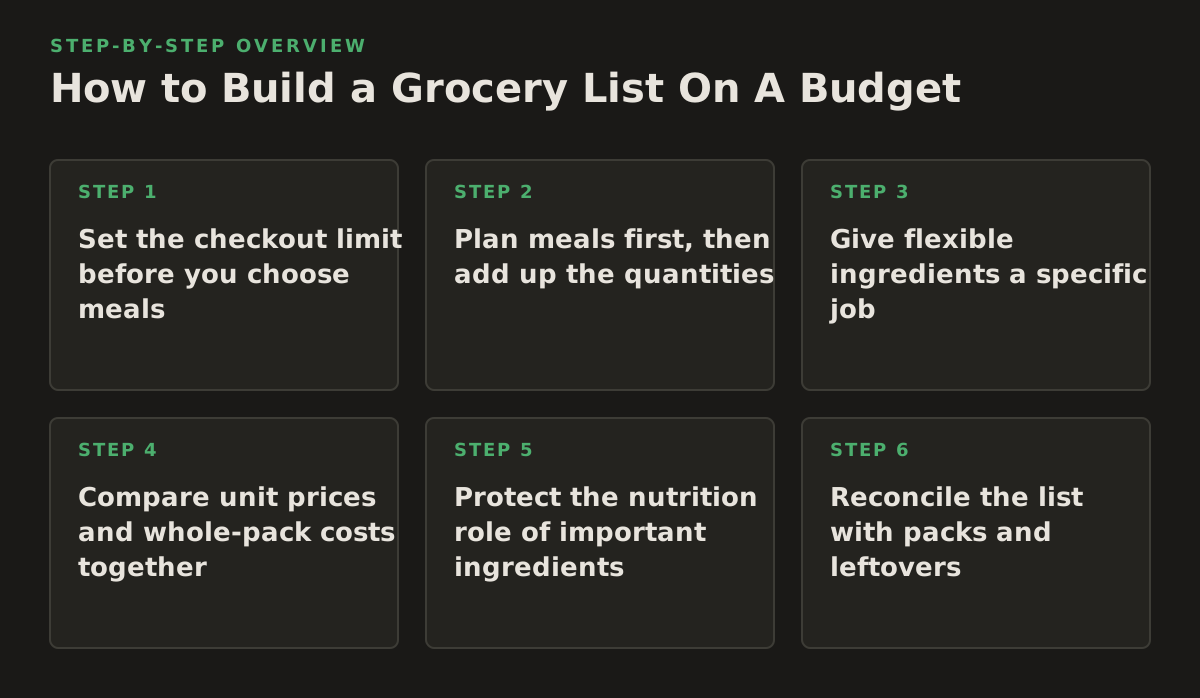
1. Set the checkout limit before you choose meals
When it applies: Start here if a rough list tends to grow in-store, or if a meal plan appears affordable until you account for pack sizes and household essentials.
Why it works: A clear ceiling gives every later choice a test: does the planned shop fit? Decide whether the limit covers food only or also items such as cleaning products. If it covers both, set those essentials aside first. Then check your pantry, fridge and freezer so you do not budget to replace something you already have—or count an almost-empty pack as enough.
Keep a small buffer as a policy, not a promise
Prices and pack sizes can differ from your estimate. You can choose to hold back some of your available budget for that uncertainty, but there is no single buffer that fits every household. For example, with an illustrative $100 available for food, you might decide to plan a $90 shop and leave $10 unallocated. That is a way to demonstrate the decision, not a recommended budget or a claim about typical grocery costs.
- Write down the maximum checkout spend.
- Subtract non-food essentials if they share the same limit.
- Record what you have and its usable quantity.
- Change the meal plan before shopping if its estimated pack total is too high.
Failure mode: Budgeting only for the food portions used in recipes. If a dish calls for 200 g of an ingredient sold in a larger pack, the portion cost may fit while the checkout cost does not. Keep both figures separate from the start.
2. Plan meals first, then add up the quantities
When it applies: Use a quantity map when several people share a shop, when you cook for one, or when macro targets make serving sizes important. It turns “buy some chicken and vegetables” into amounts you can match to products.
Why it works: Repeating a few meals can make ingredients easier to use across the week and reduce the number of separate items on your list. Start with meals you will actually eat, then total each ingredient across all planned servings. Dietary needs vary; the Australian Dietary Guidelines offer general context for variety and food groups, not an individual meal prescription. See the [Australian Dietary Guidelines](https://www.eatforhealth.gov.au/guidelines/australian-dietary-guidelines-1-5).
A three-day quantity map, not a priced weekly plan
This illustrative map is for one adult and shows how portions add up. It is not a complete seven-day plan or a claim about anyone’s calorie or macro needs. Amounts below are amounts used in meals, not pack sizes or a complete shopping list.
- Breakfast, three days: 60 g oats, 200 mL milk and one banana each day: 180 g oats, 600 mL milk and three bananas total.
- Lunch, three days: 75 g dry lentils, 60 g dry rice, 100 g canned tomatoes and 150 g frozen vegetables each day: 225 g lentils, 180 g rice, 300 g tomatoes and 450 g vegetables total.
- Dinner, days one and two: 150 g raw chicken, 250 g potatoes and 150 g frozen vegetables per meal: 300 g chicken, 500 g potatoes and 300 g vegetables total.
- Dinner, day three: two eggs, 250 g potatoes and 150 g frozen vegetables: two eggs, 250 g potatoes and 150 g vegetables.
Across the three days, the map uses 900 g frozen vegetables and 750 g potatoes. Before shopping, add any oil or seasonings required and check what is already available. Then compare these totals with actual pack sizes. Do not assume the list is covered until you have allowed for whole packs and planned what happens to leftovers.
Failure mode: Choosing a different recipe for every meal without checking ingredient overlap. For this example, a fourth vegetable or a second grain adds another item to buy; include it only if a planned serving uses it.
3. Give flexible ingredients a specific job
When it applies: Use this test when you are choosing staples, frozen or canned produce, or ingredients that could fit several meals.
Why it works: A flexible ingredient earns its place when you can name the meals and amounts that use it. That makes it easier to judge whether a pack is practical, rather than treating “versatile” or “good value” as a quality in the abstract. Rice, oats, eggs, legumes and frozen vegetables may suit some meal plans; none is automatically the best choice for every household.
Make a use-case check before buying
In the three-day map, frozen vegetables have 900 g of planned use across lunch and dinner. Check the available pack against that total, then decide how you will use any remainder. A pack that is more than you need may still make sense if you will store it appropriately and use it in a planned meal. If not, consider another format or a smaller pack.
- Write the meals that will use the ingredient.
- Record the total amount needed, not just the amount for one recipe.
- Check whether the product’s form suits the meals and your storage space.
Failure mode: Buying a large pack for its apparent value without a use for the excess. A low unit price does not help if you discard what you cannot store or eat. Compare the practical cost of the pack with a smaller option, not just the price per unit.
4. Compare unit prices and whole-pack costs together
When it applies: Check unit prices when products differ in pack size or brand. In Australia, unit pricing helps compare the cost of a standard quantity; the ACCC explains how grocery unit pricing works and notes that rules and exemptions apply. Use its [unit pricing guidance](https://www.accc.gov.au/consumers/pricing/price-displays/unit-pricing-for-grocery-products) to understand what the displayed figure means.
Why it works: A common unit makes like-for-like comparisons easier, but it does not tell you by itself which product suits your meals or what you will spend today. Compare products in the same form, note both the unit price and the pack price, then check how much the plan uses. Where products differ—for example, in preparation or drained contents—confirm what quantity the displayed comparison represents.
Use the table as a reusable shortlist
Fill this in for the options you would genuinely use. The quantities are illustrative examples drawn from the three-day map, not current product packs or prices.
| Decision | Record | Example from the map | Action |
|---|---|---|---|
| Planned use | Total amount for all meals | 225 g dry lentils | Keep this amount in the meal map |
| Pack choice | Pack size and whole-pack price | Check the products available to you | Estimate checkout spend, not just portion cost |
| Like-for-like value | Comparable unit price and product form | Compare suitable lentil options | Shortlist only products that fit the recipe |
| Nutrition fit | Serving information and relevant nutrients | Check the label for the chosen product | Record meaningful differences before swapping |
| Leftover plan | Amount left and next use | Pack amount minus 225 g used | Use, store or choose another pack |
For nutrition comparisons, check the product’s own label: Food Standards Australia New Zealand explains the information included in a [nutrition information panel](https://www.foodstandards.gov.au/consumer/labelling/nutrition-panels). Different products and serving sizes can make a general comparison misleading.
Failure mode: Picking the lowest unit price without checking the pack price, product form or likely waste. The table makes those trade-offs visible before you add a product to the final list.
5. Protect the nutrition role of important ingredients
When it applies: Use a substitution rule if you track protein or other macros, or if a particular meal is intended to support a training or nutrition goal.
Why it works: A cheaper ingredient can change a meal’s nutrition as well as its cost. Decide which parts of a meal are essential, then compare substitutes using the actual serving and product information. FSANZ’s [nutrition panel guidance](https://www.foodstandards.gov.au/consumer/labelling/nutrition-panels) describes information such as nutrients per serving and per 100 g; check the specific product rather than assuming similar foods have identical values.
Mark each protein source as protected, flexible or optional
“Protected” means you will only swap it for an option that still meets the meal’s intended role. “Flexible” means a change is possible if you record the nutrition difference. “Optional” means you can leave it out if other meals already cover what you need. These are planning labels, not dietary advice or a universal protein target.
For example, if a meal uses chicken, compare a possible egg or legume alternative only after checking the amount in the serving, how it works in the recipe and the label information for the actual products. The swap may change protein, texture, cooking time or other ingredients. Write down the difference instead of treating the alternatives as equivalent.
- Put the planned serving size beside each main protein source.
- Check relevant nutrients for that portion on the label.
- Compare the cost of the portion and the cost of the full pack.
- Record any nutrition change alongside the substitution.
Failure mode: Optimising only for cost per 100 g of protein. That comparison can help shortlist products, but it does not account for whether you like the food, can use the pack, or can fit it into your meals. Treat it as one measure, not the decision.
6. Reconcile the list with packs and leftovers
When it applies: Do this whenever the amount used in a recipe is less than the pack you must purchase. It is especially useful for smaller households, where an unused remainder can be a significant part of the shop.
Why it works: Track two different totals: meal use, the amount your plan consumes, and checkout spend, the price of the packs you buy. The first helps you understand portions and leftovers. The second tells you whether the shop fits the budget. Do not charge the entire pack price to every meal if some of the pack will be used later; record the remainder and assign it a realistic next use.
Make every remainder a decision
If your plan uses 225 g of dry lentils, list the full pack you need to purchase and the whole-pack price you see while shopping. Record the unused amount as pack size minus 225 g. Then decide whether it belongs in a later meal, can be stored according to its directions, or makes a different pack or ingredient more sensible. For products needing careful handling, follow the label and relevant food-safety advice; FSANZ provides [food safety information for consumers](https://www.foodstandards.gov.au/consumer/safety/food-safety).
Failure mode: Treating leftovers as future food without checking storage or naming a meal that uses them. If there is no realistic next use, the apparent saving may turn into waste.
7. Put the method into practice before your next shop
Follow this sequence so that product comparisons happen after you know what the meals need. If a current price or pack size affects your decision, verify it in the retailer’s shopping information when preparing the list; an earlier estimate is not a guarantee of today’s checkout total.
- Set the checkout ceiling. Decide what the budget covers and reserve for any non-food essentials included in it.
- Check what you own. Note usable pantry, fridge and freezer items and their approximate quantities.
- Choose a compact meal rotation. Pick meals you will eat, with serving sizes that fit your household and nutrition needs.
- Total ingredient quantities. Add amounts across all meals, then check for ingredients the plan has not counted.
- Match totals to packs. Record pack sizes, whole-pack prices and likely leftovers for the products available to you.
- Compare and adjust. Use unit prices for comparable products; if the estimate exceeds the ceiling, revise a meal or choose a suitable substitute and record its nutrition difference.
- Shop from the reconciled list. Note any pack or price change that affects your estimate, and revise the plan rather than relying on a portion-cost figure alone.
For Coles shoppers who want to connect macro targets with meal and whole-pack cost estimates, Macronomics is designed to support that planning, including protein-cost comparisons. If that fits your workflow, visit Macronomics to learn about its staged beta onboarding.
Authored with NotFair SEO