Customised Meal Plan: Build Around Macros, Protein and a Realistic Coles Budget
Joey Habib · · 10 min read
- customised meal plan
- meal planning
- macro tracking
- grocery budgeting
- protein
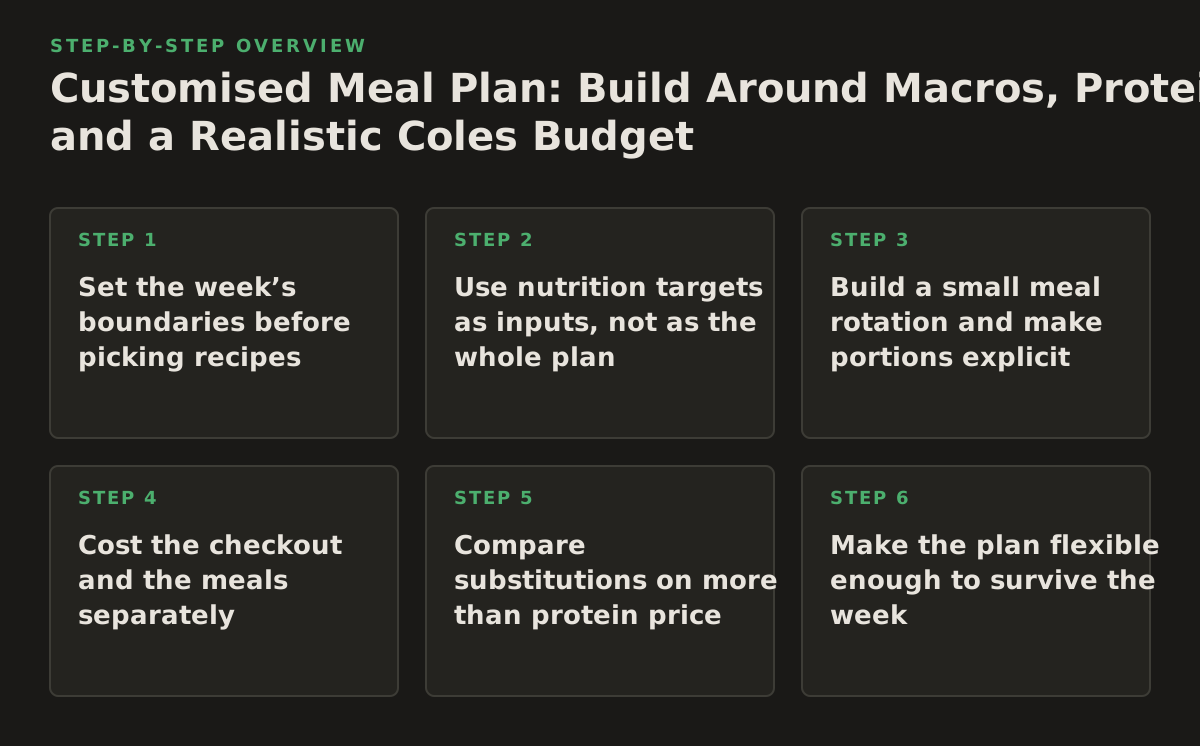
A customised meal plan turns your nutrition targets, preferred foods, weekly schedule and grocery budget into meals you can actually shop for and prepare. The practical decision is not just what each meal costs on paper: it is whether the portions fit your plan and the full packs you need fit the shop. Use the steps below to build a repeatable week, compare realistic substitutions and keep the numbers useful without treating an app target as medical advice.
1. Set the week’s boundaries before picking recipes
Start with the week you have, not an ideal week. This step matters when work, training, family meals or cooking time vary from day to day. A plan built around your actual routine is easier to follow and easier to cost: you can identify which meals need to travel, which can use leftovers and where a quick fallback is useful.
Write a short planning brief before choosing ingredients. Separate food requirements from preferences: an allergy or medical restriction is not simply a preference to be traded away for a cheaper product. If you need a therapeutic diet, have a health condition affecting food choices, or have a history of disordered eating, ask an appropriately qualified health professional for individual guidance. Healthdirect’s healthy eating overview is general information, not a personalised meal prescription.
Make the brief concrete
- Schedule: Mark meals that need to be portable, quick, cooked at home or made from leftovers.
- Household: List allergies, dietary requirements, preferences and foods people will not eat.
- Budget scope: Decide whether your weekly amount covers only meal ingredients or also snacks, pantry restocks and household goods.
- Nutrition approach: Record the macro or protein target you already use and where it came from.
Failure mode: Comparing a meal-only estimate with a checkout total that includes coffee, oil or non-food items. For example, keep those items in a separate list if your question is whether the week’s planned meals fit the food budget. The distinction makes the comparison meaningful without pretending those purchases do not matter.
2. Use nutrition targets as inputs, not as the whole plan
Choose a nutrition structure you can repeat. This applies whether you track protein and other macros closely or simply want meals with a dependable mix of foods. If you already have appropriate daily targets, allocate them across the meals and snacks you expect to eat. The split is a planning choice, not a universal rule: someone who misses protein at lunch may put more attention there, while another person may need a portable option after training.
If you do not track every macro, use a simpler meal pattern: choose a protein food, add a carbohydrate food, include vegetables or fruit, then choose sauces and fats in amounts that suit the meal. The Australian Dietary Guidelines describe the five food groups and provide a reference for variety across a diet; use them as a broad check, not a rule that every plate must look identical. See Eat for Health’s Australian Dietary Guidelines.
Allocate targets to real meal slots
As an illustration—not a recommended target—someone who has chosen a daily protein target of 120 grams with an adviser or their own established approach could divide that amount among breakfast, lunch, dinner and a snack. They would then select portions that make the target workable with their preferences and schedule. The example shows how to plan around a target; it does not establish what another person should eat.
- Identify meals where the target is usually hardest to meet.
- Choose a few protein options that suit the household and the shop.
- Leave some flexibility for a changed schedule or appetite.
Failure mode: Assuming a protein total proves a plan is balanced or suitable. It does not, by itself, account for variety, overall energy needs, fibre or a medical restriction. For instance, if a plan hits its protein number but repeatedly omits fruit and vegetables, review the meal pattern rather than celebrating the number alone.
3. Build a small meal rotation and make portions explicit
Plan components before collecting recipes. This works when you want variety without buying a unique ingredient for every meal. Select a short rotation of protein foods, carbohydrate foods, vegetables or fruit, and flavour additions; then combine them in ways that fit your available cooking time. A cooked ingredient might appear in a bowl one day and a wrap another day, provided the portions and other ingredients are adjusted to match.
Use a meal matrix
Make a grid with meal slots down one side and component options across the top. For example, lunch slots might allow leftovers, a sandwich or a grain bowl. List only ingredients you are willing to prepare and eat. This turns “What should I cook?” into a practical choice among options you have already considered.
When you record a meal, distinguish the amount eaten from the amount purchased. If a recipe uses part of a pack, calculate the meal’s nutrition from the portion used and plan where the rest will go. Food Standards Australia New Zealand explains the information shown on nutrition information panels, including per-serving and per-100-gram figures. When comparing similar products, use the same basis and check the serving size on each pack.
Failure mode: Logging a generic entry that does not match the product or food state. Dry and cooked ingredients, for example, should not be treated as interchangeable quantities. In your notes, specify the product, portion and whether it is measured dry, cooked or as sold. If you change brands, check whether the label changes the calculation.
4. Cost the checkout and the meals separately
A meal’s ingredient share is not the same as the money needed at checkout. This distinction matters when packs are large, ingredients are expensive or recipes use only a small amount of a product. A plan can look affordable by assigning half a pack’s cost to one meal while still requiring the whole pack to be bought this week.
For each ingredient, record the product, pack size, price you observed, amount used and whether you already have it. Keep the price date with the entry if you revisit the list later: prices and available products can change, so an old estimate should not be mistaken for a current shelf price.
| Planning view | Question | What to record | Use it to |
|---|---|---|---|
| Checkout | What will I need to spend to buy this week’s ingredients? | Whole packs required, current observed prices and usable pantry stock. | Check the grocery budget. |
| Meal share | How much of the ingredient is used in this meal? | Portion used and its share of the pack cost. | Compare meals or recipe changes. |
| Leftover plan | Where will the unused amount go? | Quantity remaining and the meal or storage plan for it. | Reduce forgotten leftovers and repeat purchases. |
For an illustrative example, suppose a planned meal uses half a pack. The meal-share estimate can assign half the pack cost to that meal, while the checkout estimate includes the whole pack if you must buy it. If another planned meal uses the rest, allocate the cost across the two meals rather than counting the same pack twice.
Failure mode: Calling the sum of recipe portions the cost of the shop. Before deciding that a plan fits, check which packs must be purchased now and which ingredients are already on hand. That simple check is especially useful for condiments and other products used a little at a time.
5. Compare substitutions on more than protein price
Use protein cost as a shortlist tool, not a final verdict. When two products can fill the same role, divide each product’s price by the protein it contains, then compare on a common basis such as cost per 100 grams of protein. Use the pack’s nutrition panel and price you observed; do not compare one product’s per-serving number with another’s per-100-gram number.
This comparison is most useful when you are choosing between genuine alternatives for a meal. It is less useful when the products differ in ways that change the recipe or make one option unsuitable for the household. Taste, preparation, pack leftovers, dietary requirements and other nutrients still matter. A cheaper protein amount is not a saving if the product is not used.
Run a substitution check
- Name the job: Is the ingredient meant to provide the main protein, add flavour or make the meal portable?
- Compare like with like: Use the same label basis and a price observed for each product.
- Recalculate the portion: Check whether the new amount changes the meal’s protein or other macros.
- Check the pack: Record the checkout cost and decide how any unused amount will be used.
For example, if you replace a product in a lunch, do not carry over the original macro entry automatically. Check the replacement’s label, then adjust the meal portion or another component if needed. FSANZ’s guidance on allergen labelling is also relevant when a substitution affects someone with an allergy: check the specific product’s label rather than assuming similar products share the same ingredients.
Failure mode: Choosing the lowest cost per protein amount without checking whether the replacement fits the meal. Make one change at a time, compare the revised meal and shop totals, and keep the original option if the apparent saving brings an unacceptable trade-off.
6. Make the plan flexible enough to survive the week
Plan one fallback and mark swappable ingredients. This matters when work, training or family plans can change at short notice. A fallback meal made from familiar ingredients can prevent one missed shop item from forcing a complete rewrite. Choose options that suit your household, storage space and cooking habits rather than assuming there is one ideal emergency meal.
- Mark ingredients that can be replaced by another product with the same role.
- Identify which meals can use leftovers and how much they need.
- Keep a flexible meal slot if your schedule is unpredictable.
- Check the label and revise the portion when the replacement differs.
Failure mode: Planning more batch-cooked portions than you can store or want to eat. As an illustrative starting policy, plan only the portions your schedule supports, then decide in advance which leftovers will be refrigerated, frozen or used in another meal. Follow reliable food-safety advice for handling and storage; do not assume a prepared meal stays safe indefinitely.
A simple fallback also makes tracking easier. If a planned dinner changes, record what you actually ate and note which ingredient or portion changed. That record tells you whether the problem was a missing product, an unrealistic cooking assumption or a meal that did not suit your week.
7. Put the Customised Meal Plan into action
Use this sequence for your next planning cycle. It moves from the decisions that constrain the week to the price and portion checks that make the list usable.
- Write the brief. Note the schedule, household requirements, nutrition approach and what your grocery budget includes.
- Choose meal slots. Mark which meals need to be quick, portable, batch-cooked or flexible.
- Build a compact rotation. Select repeatable meal components and assign portions using the products you expect to buy.
- Make the shopping list. Record pack sizes, observed prices and pantry stock; separate checkout cost from meal-share cost.
- Test the swaps. Compare suitable alternatives for price, nutrition, pack leftovers and household acceptance.
- Review the week. Note meals skipped, ingredients left over and portions that did not work. Change the relevant assumption before rebuilding the whole plan.
Recommendation: Keep the first version simple enough to check: a small meal rotation, clear portions and a separate whole-pack total are more useful than a detailed plan built on guesses. Macronomics is designed for Australian Coles shoppers to plan around macro targets, estimate whole-pack grocery costs and compare protein costs; its beta uses staged onboarding, so check what Macronomics currently offers before relying on it for a planning workflow.
Authored with NotFair SEO